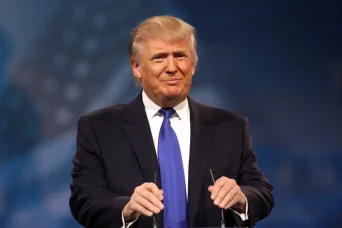
Jamie Dimon says the dollar's place as the world's reserve currency isn't guaranteed by history — it depends on the U.S. keeping the world's strongest economy. The JPMorgan Chase CEO made that argument during a Bloomberg Tech interview with anchor David Westin this week, and repeated it in a Wall Street Journal op-ed published Monday.
His ask for Washington: finish trade deals with allies while the country still has leverage.
Trade deals before tariffs
Dimon's pitch rests on a simple chain of reasoning. The U.S. sits between the Atlantic and Pacific oceans, which he called a genuine economic advantage — "not fantasy," in his words. That advantage, he argued, underwrites both the military and the dollar's reserve role. Let the trade relationships fray, and the foundation gets shaky.
He pointed to 40 military alliances and 20 free trade agreements that the U.S. currently maintains. The Office of the U.S. Trade Representative counts free trade agreements in force with 20 countries, matching his figure.
Dimon conceded that unfair treatment in existing arrangements should be fixed. But fixing them isn't his priority. "But my view is we should try to get these trade deals done," he said.
A US-Europe pact, with room to grow
In the WSJ op-ed, Dimon went further than general encouragement. He proposed a sweeping U.S.-Europe free-trade agreement, offered in exchange for European economic and military reforms, as CNBC reported. The U.S.-Europe deal could later extend to Canada, Mexico, Japan, South Korea, Australia, and the Philippines, according to Dimon.
The proposal lands against the Trump administration's protectionist tariff policies, which CNBC noted have been the White House's preferred approach. Dimon's argument runs in the other direction — keep the Western world together for trade rather than pick fights with it.
The numbers behind the case
Foreign investors hold somewhere between $20 trillion and $30 trillion in the U.S., according to Dimon. American companies hold nearly equal sums abroad. That two-way exposure is the practical reason the dollar's status matters beyond currency traders.
For crypto investors watching dollar strength, the interview ties currency dominance directly to trade policy. A dollar whose reserve status rests on trade relationships is a dollar exposed to political decisions about those relationships. Dimon has long criticized Bitcoin, and Strategy CEO Phong Le recently made the half-joking claim that Dimon privately backs it. Nothing in this week's remarks suggests a change in his public position.
What to watch
The concrete question is whether the administration shifts from tariffs toward new agreements. If it does, Dimon's argument gains traction. If it doesn't, the op-ed stays a suggestion from a bank CEO with a platform and a thesis.
Dimon's specific proposal — a US-Europe pact with an expansion list attached — is now on the record. Whether anyone in Washington picks it up is a different matter.