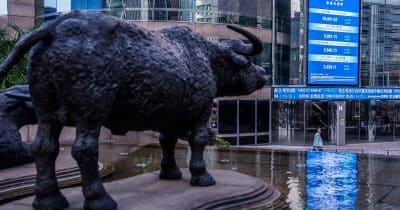
The Hang Seng China Enterprises Index is sliding toward bear market territory, as lackluster consumer spending data drives a broader rotation into artificial intelligence plays. The shift is rattling global investors who had already priced in a tepid Chinese recovery, and it's altering risk appetite across emerging markets.
Consumption data disappoints
Recent readings on Chinese retail sales and household spending missed expectations, suggesting the post-pandemic bounce is fizzling out faster than many anticipated. The weakness is concentrated in discretionary goods and services, while essential categories hold relatively steady. Analysts point to lingering consumer caution and a property sector that refuses to stabilize as the main drags.
The index, which tracks the largest Chinese companies listed in Hong Kong, has fallen more than 15% from its recent peak. A bear market is typically defined as a drop of 20% or more from a high. If the current trajectory holds, that threshold could be crossed within weeks.
Capital flows toward AI bets
In a stark contrast, money is pouring into companies tied to artificial intelligence — both in China and globally. The pivot is being driven by a combination of government policy support and corporate investment announcements. Chinese tech giants have accelerated their AI spending, while state-backed funds are directing capital toward semiconductor and data-center projects.
That strategic reallocation is showing up in index composition. AI-related stocks have outperformed the broader market by a wide margin this quarter, even as consumer and real estate names sink. The divergence is creating a two-speed market that is making it harder for passive investors to simply buy the index.
Global risk appetite takes a hit
The consumption-weakness, AI-strength pattern is not just a China story. International fund managers are recalibrating their portfolios, trimming exposure to emerging-market consumer plays and adding to tech-heavy positions. The net effect is a drop in overall risk appetite for the region, as the AI rally is seen as speculative and concentrated.
The Cboe China ETF volatility index has ticked higher in recent sessions, reflecting uncertainty about how long the consumption slump will last and whether AI investment can fill the growth gap. Some traders worry the pivot is crowding out other sectors that need capital, such as manufacturing and services.
The next major test comes later this month, when the People's Bank of China is expected to announce its latest policy rate decision. Investors will be watching for any signal that Beijing is preparing fresh stimulus aimed directly at household demand — rather than doubling down on supply-side tech spending. If the data keeps softening, the index could breach bear territory before the central bank's next move.