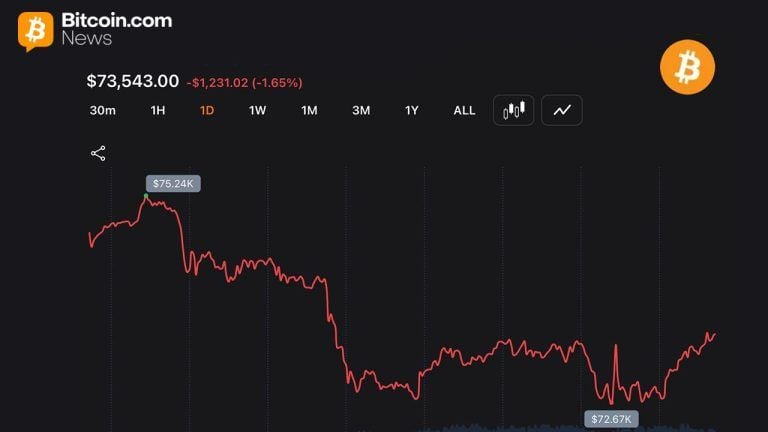
Bitcoin slid to an intraday low of $72,792 on Thursday as military clashes between the US and Iran escalated near the Strait of Hormuz, dragging the broader crypto market into a sharp sell-off. The largest cryptocurrency recovered slightly to $73,274 within 24 hours, but the damage was wide — Ether dropped below $2,000, and most altcoins followed lower. Crypto derivatives markets saw $930 million in liquidations across 166,130 accounts, with $870 million of that in long positions.
Airstrikes and oil spike
The US military launched airstrikes on Iranian drone-control units near the Strait of Hormuz using F/A-18 fighter jets, after reported Iranian UAV attacks on commercial vessels. Iran's Islamic Revolutionary Guard Corps retaliated by striking a US airbase in Kuwait, marking a dangerous escalation in a region that handles 25% of global oil shipments. Brent crude futures surged 5% to over $96 per barrel, adding to the risk-off mood across financial markets.
Crypto derivatives bleed $930 million
The liquidation wave hit derivatives hard. The $870 million in long positions wiped out overleveraged traders, while short sellers collected. Exchange data shows 166,130 accounts were caught in the cascade. The timing isn't great — the market was already skittish after weeks of regulatory noise in the US, and now a geopolitical shock has piled on.
ETF outflows spike, led by BlackRock's IBIT
US spot Bitcoin ETFs recorded $733.4 million in net outflows on the day. BlackRock's IBIT alone accounted for $527.82 million, suggesting institutional investors are pulling cash amid the uncertainty. The outflow is the largest single-day withdrawal in months for the fund.
Altcoins and Hyperliquid take a hit
Ethereum dropped 5% below $2,000. Solana, BNB, XRP, Cardano, and Dogecoin all declined. Hyperliquid (HYPE) reversed sharply from its all-time high above $64 to near $55, losing over 9%. Crypto analyst Rachael Lucas of BTC Markets linked the broad decline directly to the US-Iran tensions and the unresolved uncertainty around the Strait of Hormuz. With oil prices climbing and no diplomatic resolution in sight, risk assets — crypto included — are likely to stay choppy.