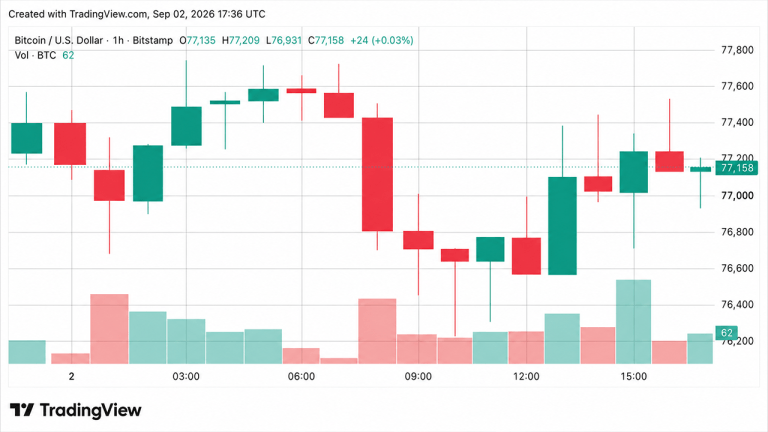
Bitcoin continues to trade sideways in the high $70,000 range, unable to reclaim the $82,000 level since mid-May. The $76,000 price zone has been tested three weeks in a row and held each time, cementing itself as a support floor. Now traders are watching an on-chain metric that has historically called every major cycle bottom — and it's flashing the same pattern again.
The $76,000 floor that keeps holding
Bitcoin tested the $76,000 level again this week and bounced. It's the third week in a row that level has been probed, and each time it's held. That consistency is giving some market participants confidence, even as the price sits at $75,269 — down 2.84% in the last week and nearly 4.65% on the weekly chart. The monthly chart shows a 3.55% decline. The Fear & Greed Index is at 28, squarely in fear territory.
A historically reliable bottom signal
The metric in question is the ratio of the 6-month-to-10-year realized price ($60,316) to the 0-to-10-year realized price ($64,412). That ratio currently stands at 0.936. Historically, every time it has dropped below 0.936 and then recovered to 1.0, it has marked the exact bottom of a Bitcoin cycle. The pattern held in the 2015 bear market, the 2018–2019 bottom, and the November 2022 low. Each time, the recovery to 1.0 took between 50 and 66 days.
What the timeline looks like
If history repeats, the definitive bottom window could open around mid-to-late July 2026. In 2015 it took 59 days to climb from 0.936 to 1.0. In 2018–2019 it took 66 days. In November 2022 it took 50 days. That puts the potential reversal somewhere in late July, give or take a week. No one's calling it a guarantee — but the track record is hard to ignore.
Near-term outlook from CoinCodex
In the short term, CoinCodex analysts are predicting a short squeeze toward $83,354 over the next five days, followed by a pullback to $77,741 in a month. Their three-month target sits at $90,529. Whether that timeline aligns with the on-chain metric's signal remains to be seen — but for now, all eyes are on whether the ratio can hold above 0.936 and start its climb toward 1.0.