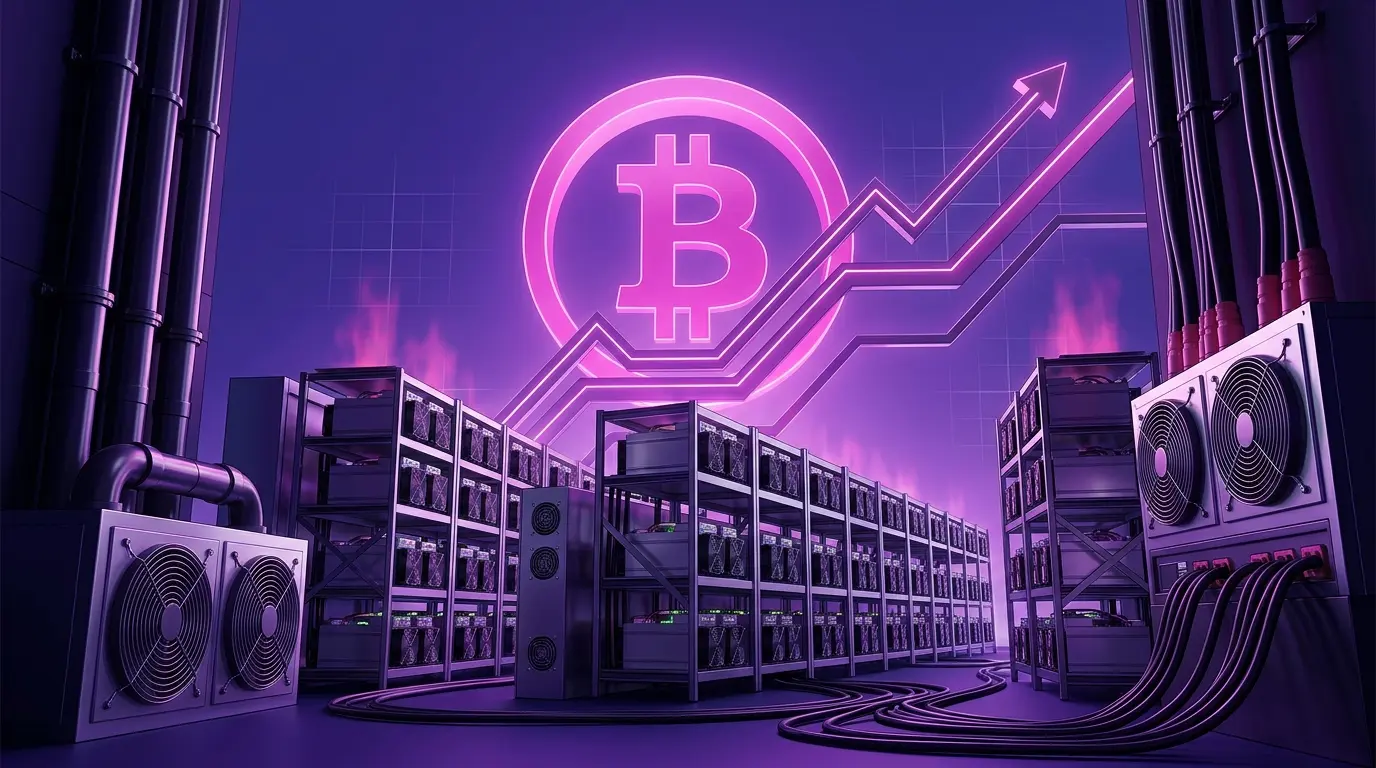
Bitcoin miners are redirecting billions of dollars and massive power capacity toward artificial intelligence as a prolonged downturn in crypto mining profitability forces a strategic pivot. With Bitcoin trading around $64,000 — nearly 50% below its October peak — and hashprice falling to about $30 per petahash per second per day, miner daily revenue has dropped nearly 40% year-over-year to an average of $28.5 million. The April 2024 halving, which cut the block subsidy from 6.25 BTC to 3.125 BTC, continues to squeeze margins, pushing profitability near historic lows.
The numbers behind the pivot
CoinShares reports that public miners have announced more than $70 billion of cumulative AI and high-performance computing contracts. Listed Bitcoin miners could derive as much as 70% of their revenue from AI by the end of 2026, up from roughly 30% today. The shift isn't about converting mining ASICs into AI hardware — it's about repurposing access to electricity, grid connections, land, and data-center infrastructure. MARA Holdings CEO Fred Thiel put it bluntly: 'You get a lot more money per electron if you're doing it for AI than for Bitcoin mining.'
Core Scientific's AI bet
Core Scientific offers a stark example of the transition. The company no longer plans to spend on new Bitcoin mining equipment; instead it is directing more power toward high-density computing. Its colocation revenue surged to $136.7 million from $10.6 million a year earlier, accounting for about 83% of total revenue. Meanwhile, Bitcoin self-mining revenue fell 66% to $21.5 million, representing just 13% of total revenue. The pivot is reshaping the company's entire business model.
The cost of switching
But the AI pivot comes with a hefty price tag. Bitcoin mining infrastructure costs roughly $700,000 to $1 million per megawatt, compared with about $8 million to $15 million per megawatt for AI infrastructure. That's a tenfold increase in capital expenditure. The SpaceX-Anthopic deal — which validates miners' bet on electricity scarcity — also exposes them to competition from deeper-pocketed technology platforms that can outbid them for power and data-center space.
A word of caution
Not everyone is convinced the rush to AI is a sure bet. André Dragosch, head of research at Bitwise Europe, warns that miners may regret the AI pivot within the next 12 months if Bitcoin recovers. He argues that expectations for AI compute demand, including from autonomous agents, could take longer to materialize than current investment implies. Dragosch believes Bitcoin is approaching the end of its downturn. The question now is whether miners can afford to wait — or whether they'll be stuck with expensive AI infrastructure if the crypto market bounces back before the AI contracts pay off.