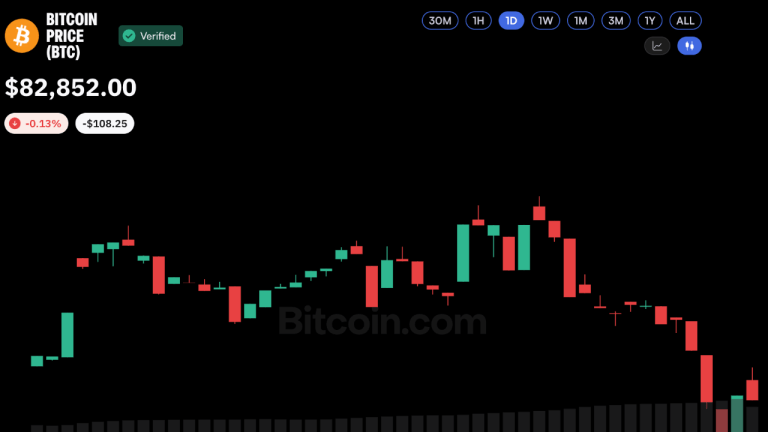
Bitcoin briefly pushed back above $84,000 after sliding toward $80,000 during last week's selloff, while Ethereum recovered above $2,500 but left a telling footprint in its derivatives market. The bounce looks technical more than confident — Bitcoin is now bumping into the exact price band where a lot of investors bought in, and Ethereum's big traders have quietly cut their bullish bets.
A wall of cost basis between $84K and $85K
Bitcoin's climb has taken it right up to a concentration of investor acquisition costs sitting between $84,000 and $85,000. That's where selling pressure tends to intensify, because holders who bought in that range are suddenly back at breakeven and often look to exit. When the cryptocurrency was trading around that level, roughly 53% of Bitcoin's invested capital had an estimated acquisition price above $83,000.
If buyers can't punch through the $84,000 to $85,000 band, the $77,000 to $79,000 range is the next area likely to act as support.
Ethereum traders are hedging, not buying the dip
Ethereum's options data tells a less upbeat story. Both its 30-day and 180-day open-interest deltas were negative, and the Whale vs. Retail Delta indicator weakened. In plain terms, the big accounts have reduced their bullish exposure and tilted toward defensive or outright short positions.
That doesn't mean they've gone away. Ethereum's total futures open interest still sat at around 10.58 million ETH — roughly $26.5 billion in notional exposure at $2,500 per ETH. A market that big, with positioning this one-sided, is a setup for sharp moves if volatility comes back.
Why the setup cuts both ways
The risk isn't just downward. If Ethereum rolls over again, leveraged longs get pushed toward forced liquidation, and that selling can accelerate losses. But a sustained recovery would squeeze short sellers and add fuel to an upward move. Either way, the fuel is sitting there waiting for a spark.
One counterweight: the spot Bid/Ask Ratio rose to 0.3, which signals stronger visible buying interest relative to sell orders. That's a modestly constructive sign, though it hasn't yet been enough to flip the broader derivatives picture.
What to watch from here
The immediate question is whether Bitcoin can clear the $84,000 to $85,000 cost-basis cluster or gets rejected back toward the $77,000 to $79,000 support zone. For Ethereum, traders will be watching whether that heavy open interest gets resolved by a liquidation cascade or a short squeeze — the whale positioning suggests the big money is braced for the former, but the spot order book is at least showing some buyers. Neither market has picked a direction yet.