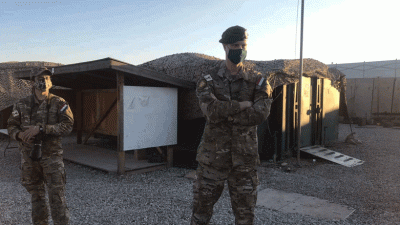
The Israeli military has repositioned forces in southern Lebanon, a move that comes under the terms of a US-brokered ceasefire agreement that remains in effect until July 25. The redeployment was confirmed by military officials on Tuesday, though they did not specify the exact number of troops involved or their new positions.
Ceasefire timeline and current status
The ceasefire, negotiated with American mediation, took effect earlier this month. It calls for a halt to hostilities along the Israel-Lebanon border and sets a July 25 deadline for its continuation. As of now, both sides have largely observed the truce, with no major violations reported in recent days.
A prediction market tracking the likelihood of the ceasefire holding through July 25 currently shows an 84% probability of success. That figure reflects trader confidence that the agreement will not collapse before the deadline, though it also leaves room for a 16% chance of renewed fighting.
What the redeployment means
Military analysts say the force adjustment is likely a tactical move rather than a sign of escalation. Israel has maintained a presence in southern Lebanon since the 2006 war, and periodic rotations are routine. But the timing — during a fragile ceasefire — has drawn attention.
Israeli officials described the operation as a “routine redeployment” aimed at improving defensive positions. They did not link it to any specific threat or to the ceasefire negotiations. Lebanese sources reported seeing Israeli vehicles moving southward, away from the border, but could not confirm whether the shift was a withdrawal or a repositioning.
Prediction market odds
The 84% “Yes” on the ceasefire lasting through July 25 comes from a decentralized prediction platform where users bet on real-world outcomes. The market opened shortly after the ceasefire was announced and has remained stable, suggesting traders see a high likelihood of the truce holding for now.
However, the same market shows lower confidence for longer-term peace. Contracts for a ceasefire lasting through August 1 trade at just 62% Yes, indicating skepticism that the current calm will extend beyond the initial window.
What happens after July 25
The ceasefire does not automatically renew. Both sides are expected to use the period to negotiate a more permanent arrangement, but no formal talks have been announced. The US has urged restraint, but underlying tensions — including disputes over border demarcation and the role of UN peacekeepers — remain unresolved.
For now, the redeployment appears to be a planned adjustment rather than a breach. But with the deadline approaching, any shift in force posture could be read as a signal. The coming days will show whether this is a routine move or the beginning of a broader change.