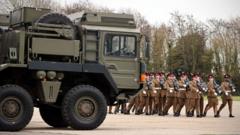
The Pentagon confirmed Sunday that it had removed B1 bombers from RAF Fairford in England and sent them back to their home stations in the United States. President Trump said a "threat" drove the decision. No further details about the nature of that threat were provided.
The timing is awkward. Markets are already jittery about a dozen other things, and now there's a military withdrawal from a key NATO staging base with almost no public explanation. For crypto, that kind of ambiguity usually means one thing in the short term: wait and see.
What actually happened at RAF Fairford
RAF Fairford has long hosted US bomber rotations, and the B1s were there as part of a standard deployment. The Pentagon's statement was brief — bombers out, home stations, done. Trump's comment about a "threat" was even briefer, without saying whether it was military, cyber, or something else entirely.
📊 Market Data Snapshot
That lack of detail is the story. When the US pulls hardware out of a forward base, allies notice. So do markets. But without a named adversary or a clear trigger, the immediate reaction is muted. There's no scramble for safe-haven assets, no spike in volatility. Just a question mark.
Why crypto isn't panicking yet
Bitcoin is sitting around $85,500, down less than a percent over the past day but still up nearly 3% on the week. Volume is low. The Fear & Greed Index is at 73 — firmly in "Greed" territory. That's not the profile of a market bracing for a geopolitical shock.
If anything, the setup favors dip-buying rather than panic-selling. High BTC dominance means capital is already concentrated in the largest crypto asset, and neutral on-chain signals suggest no one's rushing for the exits. A vague threat from Washington isn't going to change that on its own.
The contrarian read: de-escalation, not escalation
Here's the angle most coverage will miss. Removing bombers from a forward base reduces military presence. That's not an escalation — it's the opposite. If the "threat" prompted the US to pull assets out of harm's way, it could signal a cooling of tensions rather than a buildup.
Markets don't always read it that way at first, but a de-escalation narrative tends to push capital back toward risk-on assets. Gold and Treasuries lose some of their bid. Bitcoin, which has spent years positioning itself as a non-sovereign hedge, can pick up some of that flow. It's not guaranteed, but it's a plausible path.
The bigger question is what the threat actually was. If it's cyber-related, that's a different story — one that could bring regulatory scrutiny back to crypto exchanges and blockchain tracking. If it's a conventional military concern, the crypto impact is probably negligible beyond a day or two of noise.
What to watch from here
There's no scheduled follow-up from the Pentagon. That's the problem. Until someone explains what the threat was, traders are left guessing whether this is a blip or the start of something bigger. Watch for any additional US force movements in Europe or the Indo-Pacific — that would give the market a real signal to trade on.
For now, Bitcoin's range between $84,000 and $87,000 looks intact. A break above $88,000 would suggest the market is reading this as de-escalation. A drop toward $82,000 would mean the opposite. Either way, the next concrete piece of information won't come from a chart — it'll come from a Pentagon briefing that hasn't been scheduled yet.