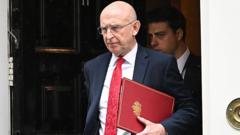
UK Prime Minister Keir Starmer said Iran's Islamic Revolutionary Guard almost certainly directed an incident at RAF Fairford. The UK responded by summoning Iran's ambassador. Foreign Secretary David Lammy said Britain won't tolerate threats on its soil.
That's about all the detail the government has put out so far. No word on what exactly happened at the base, or what form the suspected IRGC involvement took. But the language Starmer used — singling out the Revolutionary Guard by name — is about as direct as diplomatic condemnations get.
The incident and the response
RAF Fairford is a Royal Air Force station in Gloucestershire, used periodically by the US Air Force. It's not a household name, but it's a strategic asset. An incident there, attributed at the prime-ministerial level to a foreign state's paramilitary wing, is not routine.
📊 Market Data Snapshot
The UK summoned Iran's ambassador. That's a formal diplomatic step, typically a dressing-down delivered in person at the Foreign Office. It signals the government believes the evidence points clearly enough to confront Tehran directly.
Lammy's line — Britain won't tolerate threats on its soil — is the soundbite version of that position. It's firm, it's public, and it leaves room for escalation if Iran doesn't offer a satisfactory explanation.
Why crypto traders should care
Bitcoin was already drifting lower before this news broke. The asset is down 3.17% over the past seven days, sitting around $83,122 as of Monday. Volume is low. Sentiment is neutral, with the Fear & Greed index at 57 — still in greed territory, but not the kind of reading that suggests conviction.
A UK-Iran confrontation doesn't touch crypto directly. There's no exchange in the crosshairs, no token tied to either side. But geopolitical shocks tend to make traders reach for the de-risk button, and speculative assets are usually first out the door. The immediate risk is a volatility spike that tests BTC's recent support near $82,000. A break below that could trigger stop-loss cascades, pushing toward $80,000.
The counterargument: crypto's reaction to geopolitical flare-ups has been getting shorter and shallower. Last month's Middle East escalation barely registered after a few hours. If that pattern holds, this could be a wick, not a trend.
The bigger question nobody's asking
Most coverage will fixate on whether Bitcoin dips. That's the easy story. The harder one is what happens if the UK decides to respond with sanctions — specifically, sanctions targeting Iranian crypto mining and payment channels.
Iran is a meaningful player in Bitcoin mining, estimated at a few percent of global hash rate. Cutting off that capacity wouldn't break the network, but it would shuffle mining economics. More importantly, it would push the UK and its allies to tighten the screws on crypto rails used to evade sanctions. That's a regulatory story with legs.
There's a contrarian angle here too. Every time state actors get serious about using crypto to skirt sanctions, the appetite for state-issued digital currencies grows. Watch for renewed chatter about the digital pound — Britcoin, if you prefer — as a sanctions-compliant alternative for state-linked transactions. It's a backdoor to CBDC adoption that doesn't require anyone to say the quiet part out loud.
What to watch
Iran's next move. The UK has made its accusation public and summoned the ambassador. Tehran can de-escalate with a measured response, or it can retaliate. If it chooses the latter, expect a broader risk-off move across markets, crypto included.
Also watch for any UK Treasury or Bank of England commentary on the digital pound in the coming weeks. If this incident accelerates that timeline, it matters more for crypto's long-term structure than any single price swing.
For now, the market is treating this as background noise. BTC's muted 0.54% decline over 24 hours suggests traders are more focused on macro factors — Fed policy, ETF flows — than on a diplomatic spat in Gloucestershire. That could change fast if the situation escalates.