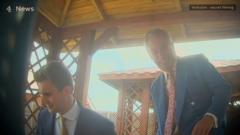
Esther Rantzen surprised Nicholas Winton with the children he saved during a 1988 episode of That's Life!, and the footage has gone viral again several times in recent years. Winton, who arranged the rescue of hundreds of mostly Jewish children from Czechoslovakia on the eve of World War II, sat in a studio audience unaware he was surrounded by the people he'd got out. The clip has no direct crypto angle. It keeps getting surfaced anyway, which is worth a look.
A clip built for the algorithm
The structure is almost too clean. A man in a suit. A host with a reveal. An audience that stands up. A payoff in under three minutes. That template — one identifiable hero, one clear turn, no ambiguity — is the same one crypto projects reach for when they tell their own origin stories. The genesis block with its newspaper headline. The DAO fork. Every token that ever sold you on a founding myth has copied this shape, whether the founders knew it or not. The Winton clip is just the original, and it keeps outperforming.
📊 Market Data Snapshot
Who gets airdropped, who doesn't
Here's the uncomfortable part. On-chain giving has settled into the same pattern as legacy philanthropy: a handful of big, photogenic causes — Ukraine relief, Wikipedia, the occasional celebrity wallet — soak up most of the volume. Famine prevention, refugee resettlement, long-horizon public health work? They don't trend. They don't fit the template. Winton's story went viral because it has a face and a moment. The systemic work he was actually doing — logistics, paperwork, bribes, months of quiet coordination — is the part nobody clips.
Nostalgia as raw material
There's a secondary market in this stuff now. Emotionally resonant historical footage gets repurposed by content farms to build account credibility before they pivot to shilling something. The Winton clip is prime stock: non-controversial, universally admired, hard to attack. It's the kind of asset that gets used quietly, without permission, to lend a little borrowed moral weight to a project that hasn't earned any of its own. The family isn't involved. The story just circulates.
The timing isn't accidental
1988 wasn't a random year for this to air. Socially responsible investing was shifting from church-basement funds into institutional strategies around then, and the regulatory scaffolding for modern finance was being hammered together in the same window. Today's tokenized philanthropy experiments — Gitcoin, Endaoment, various charity coins — are downstream of that same impulse. The Winton clip resurfacing now, while regulators are still deciding whether crypto has any social utility at all, does a small amount of soft-power work for the industry. Nobody planned that. It happens anyway.
What to watch
No trade signal here, and anyone telling you otherwise is selling something. Bitcoin is holding near $83,900 with greed sitting at 74 and dominance still elevated — the market isn't waiting on a 1988 TV clip. But the next time a charity token launches with a Holocaust-adjacent narrative or a rescued-children framing, watch how fast it gets amplified and by whom. That's the tell. The Winton footage will keep circulating either way, because it's genuinely good, and because the algorithm has never once gotten tired of it.