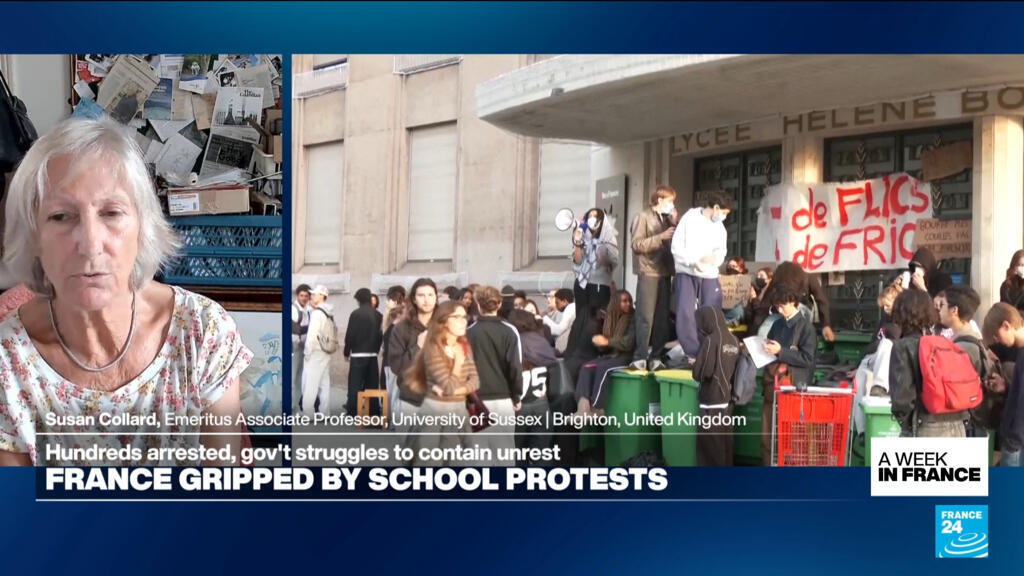
Up to 500 French high schools will stay fully or partially closed on Monday, pushing protests over crumbling classrooms, overcrowding, and teacher shortages into a second week. A nationwide day of demonstrations is set for Tuesday. France 24's Luke Shrago, reporting from outside a high school in the Paris suburb of Aubervilliers, said things were relatively calm early Monday as students tried to rebuild the momentum of last week's protests after a weekend lull.
What's actually shut
The closures aren't uniform. Some schools are fully shut, others only partially, and the exact number shifts day to day. What's driving it is concrete: buildings that need repairs, classrooms packed past capacity, and not enough teachers to staff them. Those are the grievances on the placards. They're also the reason the movement has been hard for the government to wave away as a fringe thing. Aubervilliers, where Shrago was reporting, sits in the Seine-Saint-Denis department northeast of Paris — an area where the gap between what public services promise and what they deliver is a live political issue, not an abstraction.
📊 Market Data Snapshot
Tuesday is the test
Last week's protests had numbers. The weekend drained some of that energy, as weekends tend to do. Tuesday's nationwide call is the moment to see whether this is a students-only story or something wider. Teachers' unions and parent groups have been watching the school closures closely. If they fold in, the scale changes. If they don't, the movement risks looking like a series of local skirmishes rather than a national front. Shrago's read from Aubervilliers — calm, rebuilding — captures the mood without overselling it.
A familiar French pattern
France has spent much of this decade cycling through labor and social disputes, from pension reform to transport walkouts. School infrastructure and staffing have been slower-burn issues, but they land in the same place: households absorbing costs the state hasn't covered. That matters for markets mostly at the margin. The euro has been sensitive to French political noise, and any sign that unrest is spreading tends to nudge safe-haven flows around. For crypto traders, the linkage is indirect at best. Bitcoin doesn't trade on French school closures. But persistent European social friction feeds the broader story of fiscal strain and easier monetary policy, which is the kind of backdrop that keeps a bid under non-sovereign assets over time. Right now, though, that's a slow-moving current, not a Monday morning trade.
What to watch this week
Tuesday's demonstrations are the next hard data point. After that, it's whether the closures extend into a third week. The government hasn't signaled a concrete response yet, and the grievances — repairs, class sizes, staffing — don't resolve quickly even if talks start. The number to track is the school count. If it holds near 500 or climbs, the pressure stays on. If it drops sharply after Tuesday, the movement may have peaked.