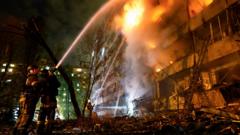
The United States carried out airstrikes against Iran for the eighth consecutive night, escalating a campaign that began after a deadly attack on a US base in Jordan. The strikes, which target Iranian military positions, mark the longest sustained US bombing operation against Iran in recent memory. A prediction market now puts the probability of a full-scale US invasion before 2027 at 29.5%.
The Trigger: Attack on US Base in Jordan
The airstrikes were launched in direct response to an attack on a US base in Jordan that killed three American service members and wounded dozens more. US officials blamed Iran-backed militias for the assault, which they described as a significant escalation. The White House vowed a forceful response, and the bombing campaign began shortly after.
Each night, US aircraft and drones have struck what the Pentagon calls “command-and-control nodes, weapons storage facilities, and other infrastructure” used by Iran’s Islamic Revolutionary Guard Corps and affiliated groups. The operations have expanded from eastern Syria into western Iran, according to defense officials.
Prediction Markets Signal Rising Invasion Risk
On Polymarket, a popular prediction platform, traders now see a 29.5% chance that the US will invade Iran before January 1, 2027. That’s up from less than 10% before the Jordan attack. The market, which allows users to bet on geopolitical events, has drawn attention from analysts who track conflict probabilities. The figure does not represent an official government assessment but reflects the sentiment of a niche group of traders.
No US official has publicly discussed an invasion. The White House has described the current strikes as “proportional and targeted.” Still, the sustained duration of the campaign has raised questions about whether the US is moving toward a broader military commitment.
What the Strikes Have Hit
Over the eight nights, the US has struck more than 85 targets, according to a defense official who spoke on condition of anonymity. Targets include missile launchers, drone storage sites, and ammunition depots. The US military says it has destroyed a significant portion of Iran’s ability to launch attacks from the region.
Iran has not confirmed the full extent of the damage. State media has reported some casualties but no official death toll. Tehran has threatened retaliation but has not yet carried out a major response. The US has maintained a heightened defensive posture, with additional Patriot batteries deployed to bases in Iraq, Kuwait, and the United Arab Emirates.
Regional Reactions and Diplomatic Fallout
Iraq’s government has condemned the strikes, calling them a violation of its sovereignty. Several Iraqi militia groups have vowed to continue attacks on US forces. In Jordan, the government has remained publicly quiet, though officials privately express concern about the conflict spilling across their border.
European allies have urged restraint. The UK and France have called for de-escalation but have not directly criticized the US campaign. The UN Security Council has not held an emergency session on the matter.
The strikes are set to continue tonight. The Pentagon has not given a timeline for when the operation might end.