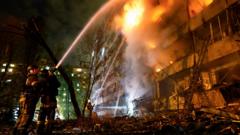
The United States has bombed Iran for an 11th consecutive night, pushing the total cost of the campaign to $38 billion. The sustained airstrikes come as prediction markets show a growing chance that Iran's airspace could be closed to civilian traffic within weeks.
What the prediction markets say
Traders on a leading prediction market now put the probability of an airspace closure by July 31 at 28%. That figure jumps to 44% for a closure by August 31. The numbers reflect a steady increase in perceived risk as the bombing campaign grinds on without a clear end date.
Airspace closures are rare in modern conflicts. They typically follow a sharp escalation — a missile strike on a civilian jet, a major ground incursion, or a direct threat to air traffic control infrastructure. The market's implied odds suggest traders see that kind of trigger as more likely than not within two months.
The $38 billion price tag
The war's cost has climbed to $38 billion, according to figures cited by officials. That covers munitions, fuel, maintenance, and deployment expenses for the 11-night bombing run. The Pentagon has not released a detailed breakdown, but the daily burn rate is among the highest of any U.S. military operation since the 2003 invasion of Iraq.
Congress has not held a formal vote on the campaign. Some lawmakers have called for briefings, but no public hearings have been scheduled. The White House has defended the strikes as necessary to degrade Iran's military capabilities and deter further attacks on U.S. assets.
What an airspace closure would mean
If Iran does close its airspace, the impact would ripple across global aviation. Major carriers like Emirates, Qatar Airways, and Turkish Airlines rely on Iranian airspace for routes between Europe and Asia. A closure would force them to take longer, costlier detours around Saudi Arabia or over the Caspian Sea.
Insurance premiums for flights over the region have already spiked. Some airlines have suspended service to Tehran and other Iranian cities. A full airspace closure would likely ground those routes entirely and could trigger a broader re-routing of international flights.
The 28% and 44% probabilities are not official government forecasts. They come from a prediction market where participants bet real money on outcomes. Such markets have a mixed track record — they've correctly called some geopolitical events and badly missed others.
The next milestone is July 31. If the airspace stays open past that date, traders will have to reassess. If it closes, the $38 billion war bill will almost certainly grow.