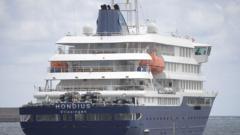
The United States, United Kingdom, and European Union are asking citizens returning from the MV Hondius to self-isolate for roughly six weeks. The request follows an outbreak on the expedition cruise ship, which operates in remote polar waters. The exact number of infected passengers hasn't been disclosed, but the length of the isolation period is drawing attention from health authorities and markets alike.
Why six weeks?
The standard quarantine for most travel-related exposures is 10 to 14 days. A six-week window suggests officials suspect the virus strain aboard the Hondius may be highly transmissible or resistant to existing vaccines. That possibility alone could reignite travel restrictions and economic uncertainty — the kind of environment that historically drives capital out of risk assets like crypto, at least initially.
📊 Market Data Snapshot
Bitcoin and other digital assets have a mixed track record during health crises. Lockdowns in early 2020 triggered a sharp sell-off, followed by a rally as central banks flooded markets with stimulus. If the Hondius outbreak leads to renewed border closures, investors might again pivot toward safety — gold, U.S. Treasuries, cash. But if governments respond with another round of fiscal expansion, crypto could benefit as a hedge against currency debasement. For now, the market is neutral, with Bitcoin hovering around $79,000 and the Fear & Greed index stuck at 42 (Fear).
The blockchain angle
This incident also puts a spotlight on digital health credentials. Traditional paper or app-based verification systems often break down when multiple jurisdictions are involved — exactly the scenario playing out with the Hondius. Blockchain-based identity solutions could offer a tamper-proof, interoperable way to prove vaccination or test status across borders. The cruise industry, which relies on smooth international travel, might be forced to adopt such systems faster. That would be a real-world use case for decentralized identity protocols, a sector that's largely flown under the radar.
Supply chain ripple effects
The MV Hondius isn't a typical cruise liner. It's an expedition vessel that carries scientists and equipment to Antarctica and the Arctic. An outbreak on board can delay research missions tied to rare earth mineral mapping and oil exploration — both of which feed into semiconductor and energy supply chains. Crypto miners depend on stable imports of ASIC hardware and predictable electricity costs. Any disruption in those chains could tighten hardware availability or raise mining expenses, though the effect would likely be slow and indirect.
What's next? Health officials are expected to release genomic sequencing data on the virus strain within the next 10 days. That will determine whether the six-week quarantine becomes a broader policy — and whether crypto markets start pricing in a new wave of uncertainty.