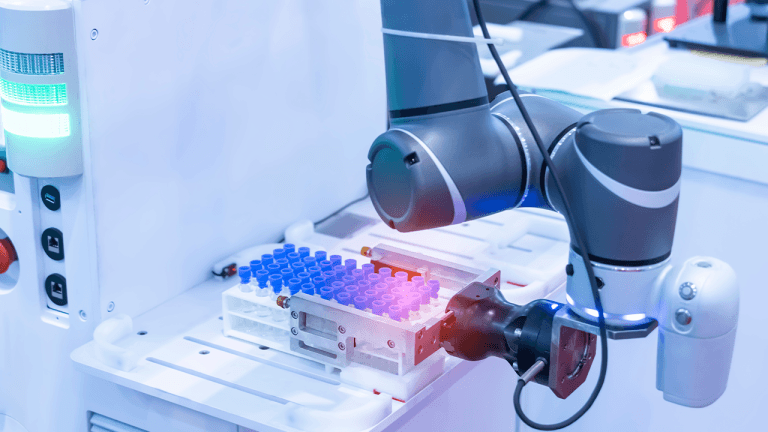
A robotic, cell-free platform that rapidly redesigns genetic codes and translates proteins with reassigned codons and non-standard amino acids was published online in Nature on 26 August 2026. The system doesn't require altering a living genome, so researchers can iterate on the genetic code the way developers iterate on smart contracts — before anything goes live. The paper landed with little fanfare in crypto circles, but a few observers see a metaphor too apt to ignore.
How the platform works
The platform is described as a robotic, cell-free setup. It speeds up the prototyping of redesigned genetic codes, letting scientists reassign codons and slip in non-standard amino acids without having to modify an actual organism. That's a meaningful shortcut. In conventional synthetic biology, changing a genome means editing a cell and dealing with the consequences. Here, the code is tested outside any living system, like running code in a sandbox.
📊 Market Data Snapshot
Nature published the research online on 26 August. It's the kind of breakthrough that gets synthetic biologists excited, and it's easy to see why. The process removes a whole layer of biological friction. You can write a new genetic instruction set and check how it behaves, no cell required.
The crypto analogy
That's exactly the idea that's getting some crypto folks to sit up. In blockchain, you don't deploy a risky change to the mainnet before testing it on a testnet. The cell-free platform does the same for genetics — you can 'test' a redesigned codon sequence without committing to a living organism. It's a biological testnet.
Some are pushing the metaphor further. If genetic code can be iterated on like software, then a DNA sequence starts to look like an executable — a smart protein, if you like. And smart proteins could one day be tokenized and validated on a chain. It's a long way off, but the principle is there: code is code, whether it's written in Solidity or in codons.
No market signal
None of this moves the needle for crypto in the next day or week. The research is isolated to synthetic biology, with no connection to digital assets, regulation, or adoption. Current market moves are driven by macro factors and Bitcoin dominance, not by a paper in Nature. The sentiment among traders is slightly bullish, but that's a separate story.
The long-term angle is thin but interesting. If the platform leads to commercial applications, it could push demand for computational resources, which might indirectly favor decentralized compute networks. But that's years out and highly speculative. For now, it's a non-event for trading positions.
What happens next
The paper is out, and the platform will likely be put through more demanding tests — more codon reassignments, more complex proteins. The research team hasn't said what they'll try first, but the next step is to see how far the system can be pushed. For crypto, the takeaway is more philosophical than practical: the same iterative loop that lets a blockchain upgrade without breaking the mainnet is now being applied to genetics. Whether that leads to a new asset class is anyone's guess. The market isn't waiting for it.