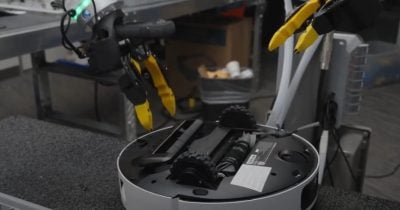
Amazon has released an updated version of its Proteus warehouse robot, one that can now understand and carry out instructions given in everyday language. The company says the upgrade uses AI-driven automation to let workers tell the robot what to do without any programming or special commands.
What the new Proteus can do
The previous Proteus, introduced in 2022, could already move carts and navigate around people. But it required pre-configured tasks or a tablet interface to set its jobs. The next-generation model changes that. Workers can now speak commands like “take this pallet to aisle seven” or “bring more boxes to packing station three,” and the robot figures out the rest on its own.
Amazon’s robotics division built the feature by combining natural language processing with the robot’s existing sensor suite. The system translates spoken English into movement plans, adjusting for obstacles or changes in the floor layout in real time. The company hasn’t disclosed the specific AI model behind it, but the shift suggests a move toward more flexible human-robot collaboration inside its warehouses.
Why plain English matters on the warehouse floor
Warehouse work is fast-paced and often loud. Most existing robots require a tablet, a scanner, or a preset routing to do anything useful. That means stopping work, grabbing a device, or calling a technician when something changes. A robot that listens and acts could cut those delays.
Amazon has been testing the new Proteus at a handful of fulfillment centers over the past few months. Early reports from the company show workers adapting quickly, with some saying they treat the robot like a new teammate rather than a machine. Amazon declined to provide specific performance figures or error rates for the speech understanding.
Where the robot fits in Amazon’s automation push
Amazon operates hundreds of thousands of robots across its warehouses. The first Proteus was notable because it could safely work alongside people without safety cages. The new version keeps that safety design but adds the ability to respond to voice commands in real time. That makes it one of the most advanced warehouse robots by a major e-commerce company.
The move also signals Amazon’s broader push to make automation more intuitive. Instead of requiring workers to adapt to the robot’s interface, the robot adapts to how people naturally talk. The company sees this as a step toward reducing training time and letting employees focus on tasks where human judgment still matters.
Still, not every warehouse task can be handled by a speech-driven robot. The Proteus can’t pick items from shelves or handle fragile goods. Those jobs still fall to human workers or to Amazon’s robotic arms, Sparrow and Cardinal. The new Proteus is really about moving things from point A to point B — just now with a voice-activated command line.
What comes next
Amazon hasn’t announced a full rollout date for the plain-English Proteus. The company says it will expand testing to more facilities later this year, but it isn’t saying how many robots or which sites will get the update first. Competitors like Walmart and Alibaba have their own warehouse automation programs, and Amazon’s voice-command approach could raise the bar for what’s expected from industrial robots.
One open question: how well the system handles accents, background noise, and multiple workers speaking at once. Amazon says its model was trained on a broad set of English speech samples, but the company hasn’t shared any independent test results.