ApeX Omni's public market configuration now lists 125 live perpetual markets — 86 crypto contracts and 39 tied to stocks, ETFs, and commodities. All of them trade from a single USDT-margined account, with leverage set per contract rather than per account.
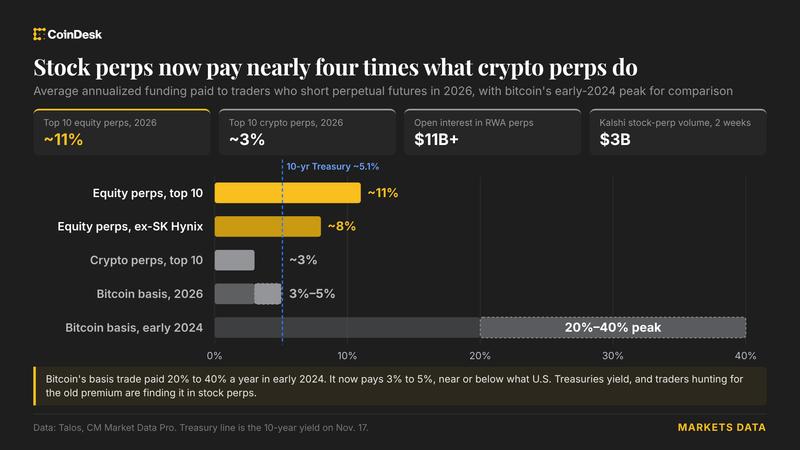
The split says a lot about where the platform has been putting its build hours. Since November 2025, ApeX Omni has been listing perpetual futures on traditional assets, priced off Chainlink's institutional RWA oracle feeds and settled in USDT. Per platform data, that TradFi book has turned over more than $13.8 billion in its first nine months.
Apple and NVIDIA, at 50x
The TradFi lineup isn't a token gesture. It includes major US equities like Apple, NVIDIA, Tesla, Microsoft, Amazon, Alphabet, Meta, Coinbase, Palantir, Micron, and Intel. There are index and sector ETFs (SPY, QQQ, EWY, SOXL), commodities spanning gold, silver, WTI and Brent crude, natural gas, and the USO oil fund, plus a memory-sector DRAM basket index. International and private-market names are in the mix too: Samsung, SK hynix, CXMT, Cerebras, Unitree, and SpaceX.
Every one of those contracts runs up to 50x leverage. Twenty-two of the 39 trade 24/7 — that group covers pre-IPO names, the chip cohort, and energy contracts. The rest follow a 24/5 schedule and close on weekends.
Where the crypto book is capped
On the crypto side, leverage is tiered by asset. BTC-USDT and ETH-USDT go up to 100x. Roughly three-quarters of the crypto contracts top out at 50x. The meme cohort — DOGE, 1000PEPE, 1000BONK, WIF, POPCAT, MOODENG, SPX — is capped at 25x, which is the most conservative setting on the board.
The contracts are sorted into sectors: Layer 1s (SOL, BNB, XRP, ADA, SUI, AVAX, NEAR, APT, HBAR, XLM), Layer 2s (ARB, OP, MNT), DeFi (LINK, AAVE, UNI, ONDO, ENA, PENDLE), AI (TAO, VIRTUAL), plus infrastructure, gaming, and memes. Recent additions include HYPE, ASTER, ZEC, WLFI, PUMP, and PAXG, the tokenized-gold contract.
Two margin pools, no crossfire
The structural detail worth knowing: TradFi perpetuals sit in a separate account with their own margin pool. A liquidation on a stock position can't cascade into crypto positions, or the reverse. That's a deliberate firewall, and it matters given how many venues have learned the hard way that one bad book can take the whole account down with it.
Inside each pool, positions are cross-margined — unrealised profit on one contract offsets unrealised loss on another. Risk limits scale the maintenance margin requirement up as position size grows. The cross-collateral pool accepts USDC, WBTC, WETH, ETH, cmETH, mETH, cbBTC, or USDe alongside USDT, each valued at its live index price.
Leverage stays adjustable per contract before or after a position is opened. Traders can raise it for more exposure or lower it at any time to widen the buffer to liquidation.
TradingView charts and a Polymarket feed
Order types cover the usual spread: limit, market, conditional market, conditional limit, and take-profit/stop-loss on every USDT perpetual. Advanced flags include time-in-force options (Good-Till-Time, Fill-or-Kill, Immediate-or-Cancel), Post-Only, and Reduce-Only. TP/SL orders can trigger on last, mark, or index price and close positions in stages. Cancelling an unfilled order costs nothing. Charting runs on TradingView.
The matching engine is a central limit orderbook with up to 10,000 transactions per second of throughput and zero gas fees on orders.
ApeX Omni also carries prediction markets synced from Polymarket's order books — thousands of live spot markets across politics, sports, and crypto, with no leverage and no liquidation. Its Political Markets Season runs from September 7 to October 4, 2026, built around four of the most actively traded political contracts. That window closes in under a week.