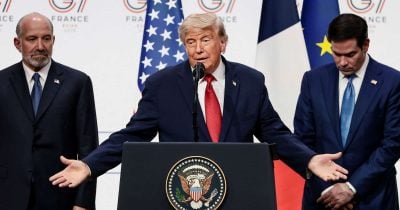
President Trump said Wednesday that stock market movements directly shaped his decision to back the Iran deal, pointing to rallies on peace signals and selloffs on escalations. The comments came as the S&P 500 closed at a record 7,554.29 and Bitcoin briefly popped above $67,000 on ceasefire headlines before sliding back to near $64,200.
Trump's Market-Driven Diplomacy
Speaking to reporters, Trump argued that the equity response to Iran developments gave him a clear read on the policy's impact. “When the market goes up on peace news and down on bad news, you listen,” he said. The president also drew an unexpected historical parallel, comparing himself to Herbert Hoover and blaming Hoover's tax and interest rate policies for causing the Great Depression. The comparison raised eyebrows given the current market highs.
Equities Hit New Records
The S&P 500 closed at a record 7,554.29 on June 15, up 1.65%. The Dow added 468.77 points to a record near 51,671, and the Nasdaq jumped 3.07%. The rally came as traders bet on a de-escalation in the Middle East, though Trump's Hoover remark injected a note of caution about potential policy missteps.
Oil Slides as Hormuz Reopening Looms
Oil fell roughly 20% from its 2026 peak as a Hormuz reopening came into view. The prospect of restored flows through the strategic strait weighed on crude, adding to the broader disinflationary signal that has been a mixed bag for crypto.
Bitcoin's Two-Way Action
Bitcoin traded near $64,200 after slipping more than 2% in a single day, pressured by the Federal Reserve cooling rate-cut bets. The dip erased a brief spike above $67,000 triggered by ceasefire headlines. The whipsaw underscores how sensitive crypto remains to both geopolitical shifts and monetary policy signals. With the Fed holding firm on rates and oil supply potentially normalizing, traders are left parsing two conflicting narratives for risk assets.
The next concrete test comes later this month when the Fed releases its preferred inflation gauge — a number that could determine whether rate-cut hopes revive or fade further.