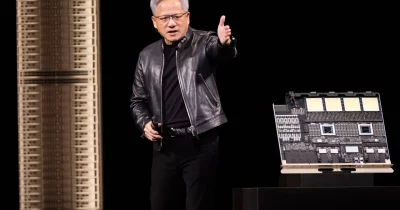
Nvidia is betting big on central processing units. The company forecasts the global CPU market will reach $200 billion, and it has its sights set on a piece of that pie — including in China. But whether Nvidia can turn that projection into real revenue depends on forces beyond chip design: geopolitical shifts and export control policies.
A $200 Billion Bet
For years, Nvidia has dominated GPUs, the chips that power AI training and gaming graphics. Now it’s looking at the CPU market, a space long ruled by Intel and AMD. The company’s internal forecast of a $200 billion total addressable market signals just how seriously it’s taking the opportunity. CPUs remain the brains of most servers, PCs, and embedded devices. If Nvidia can carve out even a fraction of that market, it would add billions in annual revenue.
The company already sells its Grace CPU for data-center workloads, pairing it with its own GPUs. But Grace is still a small player. Nvidia’s broader CPU push, likely under its Arm-based roadmap, would need to win over server buyers and cloud providers who have decades of x86 habit to break.
Why China Is in the Forecast
Nvidia’s long-term CPU projections include the Chinese market. That’s notable because China is both the world’s biggest buyer of chips and a territory where U.S. export restrictions have tightened sharply. Nvidia has already seen its advanced GPU sales to China curbed by Washington’s national security rules. Still, the company sees CPU demand in China as a growth driver — if it can legally sell there.
China’s domestic chip industry is also pushing homegrown alternatives, but foreign-made CPUs still power much of the country’s data centers and telecom gear. Nvidia’s Arm-based design could appeal to Chinese customers looking for an alternative to x86, provided export licenses allow it.
The Geopolitical Catch
Nvidia’s CPU ambitions don’t exist in a vacuum. The same export controls that hit its GPU business could apply to high-performance CPUs. The U.S. government has shown it’s willing to restrict chip sales that could strengthen China’s military or surveillance capabilities. Any CPU that meets certain performance thresholds — core count, memory bandwidth, interconnect speed — could fall under those rules.
The company’s forecast assumes a baseline of geopolitical stability. But trade tensions are escalating, not easing. If Washington tightens the screws further, Nvidia may find itself locked out of the very market it’s projecting. On the other hand, if restrictions ease or carve-outs emerge for civilian data centers, Nvidia could be first in line.
For now, the $200 billion figure is a target, not a guarantee. Nvidia will need to navigate export regulations, compete with entrenched x86 rivals, and convince customers to switch architectures. The next step is a simple one: watch how the U.S. Commerce Department updates its export control lists in the coming months. That will tell us whether Nvidia’s CPU future includes China — or leaves it out.