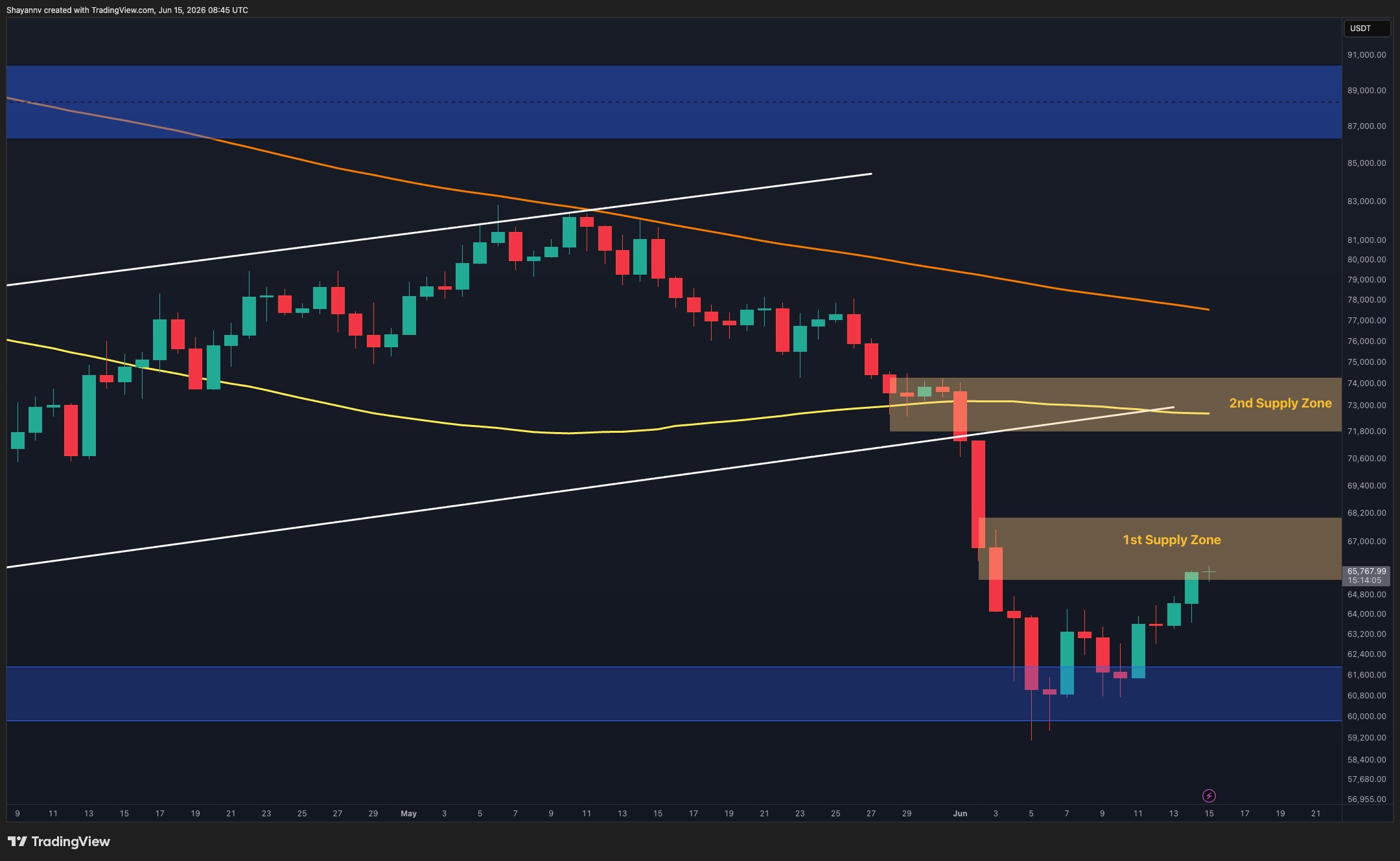
Bitcoin's network activity index crossed above its 365-day moving average this week for the first time since December 2024, entering a bull phase, according to CryptoQuant. The shift comes as daily transactions exceed 800,000 in 2026 — more than double the lows seen last year — and the activity index jumped from roughly 3,320 to around 3,600. The move signals renewed on-chain momentum, but the nature of that activity looks different than in past cycles.
What the activity index shows
CryptoQuant's network activity index tracks a broad set of blockchain fundamentals. Breaking back above the 365-day moving average is what the analytics firm considers a bull-phase signal. The data arrived alongside a partial de-escalation from the Iran peace deal, which removed some of the geopolitical risk premium that had been suppressing crypto markets. Bitcoin is holding just above the 200-week simple moving average near $62,000 — historically a long-cycle support level that's helped define the floor during previous bear markets.
Microtransactions are the story
Transactions below 0.01 BTC — roughly $630 at current prices — now account for about 80% of all daily on-chain activity, up from 44% in 2023. That surge is almost entirely driven by OP_RETURN-based protocols: Runes, Ordinals, BRC-20 tokens, and data timestamping services. OP_RETURN usage has hit near-record levels in 2026. The economic content of these transactions differs materially from prior high-activity periods, CryptoQuant noted. The transferred value per transaction is tiny — a pattern that looks more like a data layer than a settlement network.
Congestion builds in the low-fee tier
The mempool has swelled to roughly 128,000 pending transactions, its highest level since late February 2025. But the congestion is concentrated in the low-fee tier, meaning users sending time-sensitive economic payments could face delays if they don't bump fees. CryptoQuant warned that sustained protocol-driven activity could push fee pressure up for regular transactions. It's not a crisis yet, but the trend is worth watching for anyone relying on Bitcoin for settlement rather than inscription.
Long-term holders aren't selling
Long-term holders now control more than 4.37 million BTC, up from roughly 2 million in early 2024. VanEck analysis shows about 43% of Bitcoin supply has been dormant for more than three years — in the upper historical percentiles. That supply conviction adds a layer of scarcity, even as new issuance continues. The combination of a bullish activity signal, rising microtransaction volume, and growing dormant supply creates an unusual environment: the network is busy, but the economic throughput — measured in value moved per transaction — is actually quite narrow.
The question heading into the rest of 2026 is whether the protocol-driven use cases will keep fees manageable for ordinary users, or whether the noise on the base layer starts to crowd out the signal.