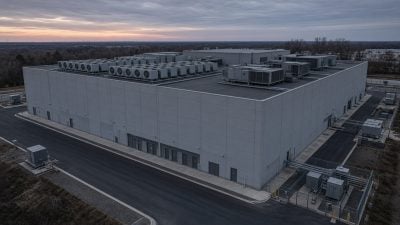
NVIDIA is taking its AI Cloud ecosystem global, signing on partners to build AI factories across six continents. The expansion, announced Monday, adds new infrastructure in Africa and South America for the first time — and it pulls in several companies that previously made their names in crypto mining.
Six continents, two new regions
Until now, NVIDIA's AI Cloud reach covered most of the world but left out Africa and South America. That changes with the addition of Cassava in Africa and Claro in South America. The full roster spans nearly every continent: CoreWeave, Firmus, IREN, Nebius, and Nscale are among the partners building out capacity. Firmus, for example, is developing AI factories in Tasmania, Melbourne, South Australia, New South Wales, and Singapore through a partnership with ST Telemedia Global Data Centres and a project called Project Southgate.
📊 Market Data Snapshot
Behind the builds
Firmus is building its facilities using NVIDIA's accelerated computing stack and DSX reference architecture, along with a liquid-cooled system called HyperCube. The set-up is modular, which means these AI factories can be deployed faster and scaled up as demand grows. Liquid cooling cuts power costs by roughly 30% compared to air cooling — a detail that matters when comparing costs against decentralized alternatives.
Mining's new identity
The list of partners includes IREN, a company that has steadily pivoted from Bitcoin mining into AI compute. IREN now appears as an NVIDIA partner building AI factories using the same kind of modular, liquid-cooled infrastructure originally designed for crypto mining. The overlap isn't accidental. As global AI compute demand surges more mining firms may convert their facilities to serve generative AI workloads, potentially slowing the growth of Bitcoin's hash rate and network difficulty.
Jensen Huang, NVIDIA's CEO, framed the buildout as a necessity: 'Every company and every country needs AI factory infrastructure to turn data into intelligence.' The statement reinforces the idea that AI compute is becoming a utility — and that the companies supplying it are shifting fast.
What this means for crypto markets
The news has no direct trading mechanism for bitcoin or ether, but it reinforces a broader narrative: specialized GPU assets are in demand, and companies that can provide verified, low-latency compute are positioned to benefit. For tokens like Render Network and Akash, which focus on decentralized inference rather than training, the expansion of traditional AI factories could create a distinct niche. Decentralized networks excel at distributed, latency-tolerant tasks — exactly the type of workload that will explode as agentic AI applications scale. That could be a separate growth driver, independent of NVIDIA's ecosystem.
In the near term, the market remains focused on macro headwinds, but the infrastructure buildout supports a bullish thesis for GPU-backed assets over the long haul. The next concrete milestone: as AI factories come online over the coming months, the capacity will test whether demand matches the hype.